
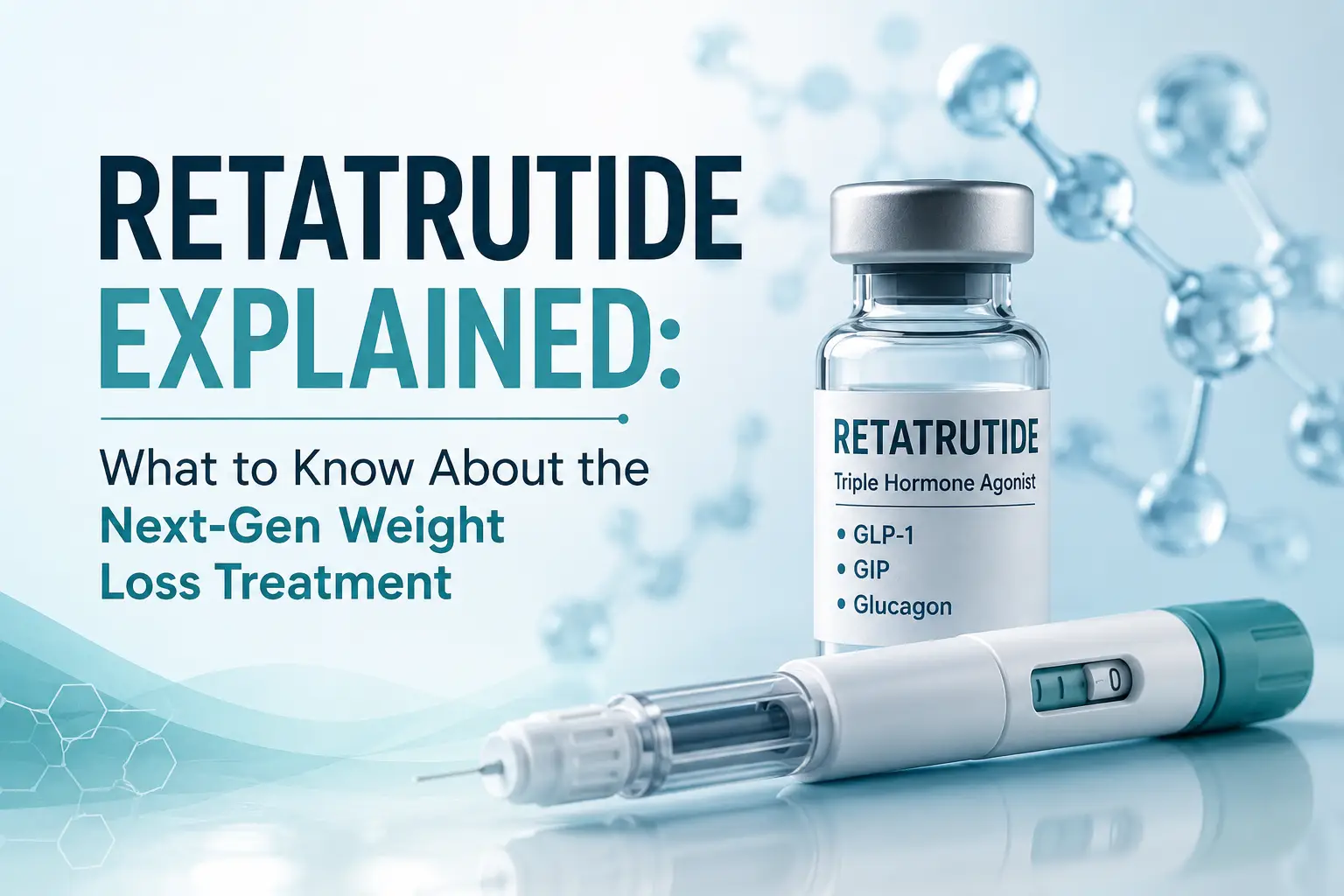
Weight loss medications have advanced significantly over the past several years, and a new contender is generating considerable interest among researchers, clinicians, and patients alike. Retatrutide—an investigational injectable developed by Eli Lilly—has drawn attention because it works on hormone pathways that existing medications do not fully address. Early clinical results have been notable.
This post covers what retatrutide is, how it works, what the research says so far, how it compares with FDA-approved options like semaglutide and tirzepatide, and what you should know about its current availability. One important point upfront: retatrutide has not been approved by the FDA. It remains an investigational medication undergoing clinical trials.
What Is Retatrutide?
Retatrutide is a once-weekly injectable medication being studied for weight management. Developed by Eli Lilly, it is designed to activate three hormone receptors simultaneously: GLP-1 (glucagon-like peptide-1), GIP (glucose-dependent insulinotropic polypeptide), and glucagon.
Because of this triple-action design, retatrutide is sometimes informally referred to as a “GLP-3” medication. That label is not scientifically accurate—GLP-3 is not an established pharmacological classification—but the shorthand reflects the medication’s broader scope compared with earlier drugs in this class.
By targeting all three receptors, retatrutide aims to influence appetite regulation, glucose control, metabolic rate, and overall energy balance. The combination is what sets it apart from current GLP-1 and GLP-1/GIP medications already on the market—though setting it apart does not automatically make it superior. Clinical evidence and regulatory review will ultimately determine its role in treatment.
How Does Retatrutide Work for Weight Loss?
GLP-1 Receptor Activation
GLP-1 signaling plays a well-established role in appetite and food intake. When GLP-1 receptors are activated, the brain receives signals that reduce hunger and promote a feeling of fullness. This pathway is shared with semaglutide and tirzepatide.
GIP Receptor Activation
GIP receptors are involved in glucose-dependent insulin secretion and metabolic regulation. Tirzepatide also targets GIP alongside GLP-1. Activating this pathway may help improve insulin sensitivity and support better blood sugar management.
Glucagon Receptor Activation
The glucagon receptor component is what most clearly distinguishes retatrutide from its predecessors. Glucagon plays a role in energy expenditure and liver metabolism. Activating this pathway is thought to increase calorie burn—an effect not directly targeted by current FDA-approved weight loss medications.
Why Target Three Hormone Pathways?
The logic behind a triple agonist is that influencing appetite, metabolic function, and energy expenditure simultaneously may produce more comprehensive effects than addressing one or two pathways alone. That said, broader mechanism does not guarantee better outcomes for every patient. Tolerability, individual response, and a person’s broader health profile all matter. Clinical trials continue to evaluate exactly how this mechanism translates into real-world benefit and safety.
What Does the Research Say About Retatrutide?
Clinical investigation of retatrutide has progressed through multiple phases, with Eli Lilly now reporting results from Phase 3 trials under the TRIUMPH program.
In TRIUMPH-1, participants receiving the highest studied dose reported an average body weight reduction of 28.3% over 80 weeks, according to data announced by Lilly. That figure has attracted widespread attention, given that it exceeds average outcomes reported in Phase 3 trials for tirzepatide and semaglutide.
More recent Phase 3 results from TRIUMPH-2 and TRIUMPH-3 also reported substantial weight loss in people with obesity or overweight and related health conditions. These results have reinforced interest in the medication’s potential.
However, trial averages do not predict individual results. How any one person responds depends on dose, adherence, lifestyle factors, and health history. Full peer-reviewed publication of the Phase 3 data and subsequent regulatory review remain critical steps for understanding the medication’s long-term safety and effectiveness.
Retatrutide vs. Semaglutide and Tirzepatide
Patients researching weight loss medications often want to understand how retatrutide fits alongside options already available. Here is a straightforward comparison:
| Feature | Retatrutide | Semaglutide | Tirzepatide |
| Primary pathways | GLP-1 + GIP + glucagon | GLP-1 | GLP-1 + GIP |
| FDA status | Investigational | Approved for obesity indications | Approved for obesity indications |
| Administration | Weekly injection (in trials) | Weekly injection | Weekly injection |
| Weight-loss research | Promising Phase 3 results | Extensive clinical evidence | Extensive clinical evidence |
| Available for routine use? | No | Yes | Yes |
The key takeaway: retatrutide is not currently a prescribable alternative to semaglutide or tirzepatide. Patients who qualify for medical weight management today have access to both of those approved medications, each supported by substantial clinical evidence. The right choice between them depends on a patient’s medical history, treatment goals, and how their provider assesses their individual needs.
Potential Benefits Being Studied
Research into retatrutide extends beyond weight reduction. Clinical trials are investigating whether the medication may also support:
- Significant body weight reduction in adults with obesity or overweight
- Improvements in blood sugar control, particularly relevant for people with or at risk of type 2 diabetes
- Reductions in obesity-related complications more broadly
- Improvements in knee osteoarthritis symptoms, based on early Phase 3 findings
- Improvements in obstructive sleep apnea measures, also noted in recent trial results
These are studied benefits, not established indications. None of them should be treated as guaranteed outcomes. Regulatory review will assess the full evidence before any specific indication is approved.
What Are the Potential Side Effects of Retatrutide?
Retatrutide’s full safety profile is still being established through ongoing clinical trials. Based on what has been reported so far, gastrointestinal effects are among the most commonly observed—consistent with what is seen across incretin-based therapies as a class. These can include:
- Nausea
- Vomiting
- Diarrhea
- Constipation
- Decreased appetite
These effects are often dose-dependent and may be more pronounced when starting treatment or increasing dose. Whether retatrutide’s triple-receptor mechanism introduces any safety considerations beyond those seen with existing medications remains an active area of study.
Before considering any weight loss medication, current or investigational, speaking with a licensed healthcare provider is essential. They can evaluate your health history, current medications, and any potential contraindications.
Is Retatrutide FDA Approved?
No. Retatrutide is not FDA-approved and should not be presented as though it were.
The medication is currently being evaluated in Phase 3 clinical trials. Eli Lilly has announced plans to submit a Biologics License Application (BLA) to the FDA in Q1 2027. That submission would begin a formal regulatory review of the medication’s safety and efficacy data—a process that takes time and does not guarantee approval.
One important warning: products marketed online as “retatrutide” are not legitimate. Since the medication is not approved or commercially available, anything sold under that name has not been reviewed or authorized by the FDA. Purchasing such products carries real health risks.
Can You Get Retatrutide for Weight Loss Right Now?
Retatrutide is not available for routine public use. According to Eli Lilly, the medication is legally available only to participants enrolled in its authorized clinical trials.
There is no pathway to obtain a legitimate prescription for retatrutide outside of a clinical trial at this time. Patients who encounter websites or compounding pharmacies offering retatrutide should treat those claims with serious caution.
If you are interested in medical weight management now, the most appropriate step is to consult with a licensed provider about currently approved treatment options. Semaglutide and tirzepatide are both available and have strong clinical evidence supporting their use.
Who Might Benefit From Future Retatrutide Treatment?
It is too early to define eligibility criteria. Approved indications, dosing guidelines, and prescribing criteria will only be established following FDA review and approval—which has not yet occurred.
That said, weight-loss medications in this class have generally been studied in adults with a BMI of 30 or above, or 27 and above with at least one obesity-related health condition. Factors that typically influence treatment decisions include:
- Body mass index (BMI)
- Existing obesity-related conditions such as type 2 diabetes, hypertension, or sleep apnea
- Current medications and potential interactions
- Medical history and previous treatment responses
- Potential contraindications
Weight-loss medication decisions are always individualized. If and when retatrutide becomes approved, determining whether it is appropriate for any specific patient will be a clinical conversation—not a self-directed one.
Where Does This Leave Patients Interested in Medical Weight Loss?
Retatrutide represents a genuinely interesting development in obesity medicine. The Phase 3 trial results are among the most compelling published for a weight-loss medication to date. But promising early data and clinical availability are two different things, and there is still meaningful ground to cover before retatrutide reaches patients outside of clinical trials. For patients seeking medical weight management support today, FDA-approved options are available and effective. Laveen Medical Weight Loss works with patients to evaluate their individual health profile and identify treatment plans grounded in current evidence. If you would like to explore your options, reach out to schedule a consultation.
FAQs
Ans: – Retatrutide is an investigational, once-weekly injectable weight loss medication developed by Eli Lilly. It is a triple hormone receptor agonist that activates GLP-1, GIP, and glucagon receptors simultaneously. The medication is currently in Phase 3 clinical trials and has not been approved by the FDA.
Ans: – Retatrutide activates GLP-1 receptors, but it is more than a GLP-1 medication. It also targets GIP and glucagon receptors, which distinguishes it from medications like semaglutide (GLP-1 only) and tirzepatide (GLP-1 and GIP). The informal label “GLP-3” is sometimes used, though it is not a recognized scientific classification.
Ans: – No. Retatrutide is not FDA-approved. It remains an investigational medication. Eli Lilly has announced plans to submit a Biologics License Application (BLA) to the FDA in Q1 2027. Until approval is granted, it cannot be legally prescribed outside of clinical trials.
Ans: – In clinical trials, retatrutide has been administered as a once-weekly subcutaneous injection, similar to semaglutide and tirzepatide. Final dosing guidance for approved use would be determined following regulatory review.
Ans: – Clinical trial data cannot predict individual results. In TRIUMPH-1, participants receiving the highest studied dose reported an average body weight reduction of 28.3% over 80 weeks, according to Eli Lilly’s announced results. Individual outcomes will vary based on dose, adherence, health history, and lifestyle factors.